


Milk-flavored tofu cat litter is a Plant-based cat litter designed to combine the functional properties of tofu-style litter with a mild, milky fragrance. It is typically manufactured in small cylindrical or strip-shaped pellets that absorb liquid, form clumps, and allow pet owners to remove used material during routine litter box cleaning.
Unlike conventional mineral-based litter, tofu cat litter generally uses plant-derived fibers and binders. Depending on the formulation, the raw materials may include soybean fiber, pea fiber, corn starch, corn flour, guar gum, or other suitable plant-based ingredients. The precise ingredient ratio varies by manufacturer and product grade.
The milk scent is a fragrance feature rather than an indication that the litter contains milk powder or dairy ingredients. Buyers who need a specific ingredient profile should check the product's ingredient declaration and fragrance information.
Milk-flavored tofu cat litter is designed for households seeking a lightweight, easy-to-scoop litter with a pleasant scent. It is also a product category of interest to pet supply distributors, retailers, e-commerce sellers, and private-label brands developing differentiated cat litter ranges.
Its actual performance depends on pellet density, fiber composition, binder content, moisture level, manufacturing consistency, and storage conditions. A product's suitability should therefore be evaluated through practical testing rather than fragrance or appearance alone.
The formulation of milk-flavored tofu cat litter influences its absorption, clumping strength, dust generation, pellet durability, and odor management. Understanding the principal ingredient groups helps buyers evaluate products more accurately.
Plant fibers form the main absorbent structure in many tofu cat litter formulations. Soybean fiber and pea fiber are common examples. Their porous structure can help take up liquid and support the formation of clumps when combined with suitable binders.
The source and processing of the fiber affect the finished product. Fiber length, particle structure, moisture content, and consistency may influence pellet strength and absorption behavior.
Corn starch, corn flour, and other suitable starch-based ingredients may be incorporated to help bind the plant fibers into pellets. The binder system affects how quickly the litter consolidates after contact with liquid and whether the resulting clumps remain intact during scooping.
Too little binding strength may lead to fragile clumps. Excessive or poorly controlled binding can also affect pellet behavior, drying, and water interaction. Formulation development therefore requires balancing absorption, clump integrity, and ease of cleaning.
Some formulations use guar gum or other binders to improve cohesion. Their concentration and interaction with the fiber base influence the final litter's mechanical properties.
A consistent production process is important because changes in raw material quality or ingredient ratios may affect clumping and pellet durability between batches.
Milk fragrance gives the litter its characteristic scented profile. The intensity may range from subtle to more noticeable, depending on the formulation.
A mild fragrance may be preferred by buyers who want an alternative to unscented litter without a strong perfume-like smell. However, fragrance preference varies among cats and owners. Some cats may avoid strongly scented litter, so gradual introduction and observation are advisable.
For commercial purchasing, buyers should request information about the fragrance ingredients and relevant safety documentation. A milk scent alone does not establish that a product is hypoallergenic, non-irritating, or suitable for every cat.
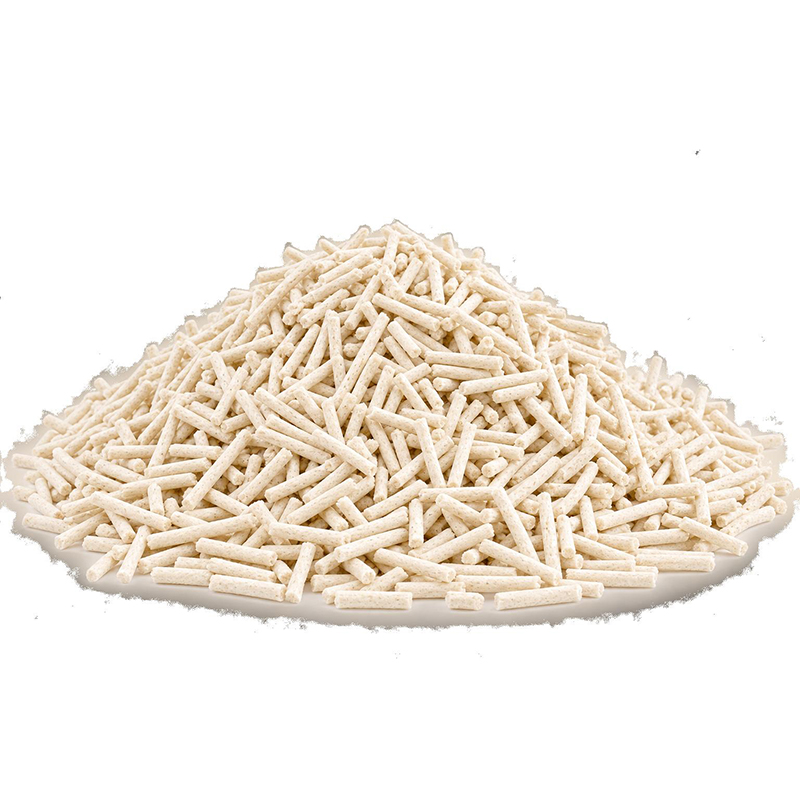
Milk-flavored tofu cat litter commonly comes in lightweight pellets made from plant-derived fibers and binding agents. The cylindrical shape provides a different texture from fine-grained clay litter.
Pellet diameter and length influence how the litter feels under a cat's paws, how easily it moves through a scoop, and how much material may be carried outside the tray.
A uniform pellet structure can also help maintain consistent performance during daily use. Buyers should evaluate whether the pellets remain reasonably intact during transport, pouring, digging, and scooping.
Absorption is one of the most important performance characteristics of tofu cat litter. Plant fibers can take up liquid, while the binder system helps the used material consolidate into removable clumps.
A well-designed formulation should allow liquid to penetrate the litter rather than simply spreading across the surface. However, the speed and capacity of absorption vary with pellet structure, liquid volume, and the composition of the product.
When comparing suppliers, request the stated absorption rate and the test method used to determine it. Results should be interpreted alongside clumping performance because high liquid uptake does not automatically guarantee strong clumps.
Clumping allows pet owners to remove used litter while leaving much of the clean material in the tray. Milk-flavored tofu cat litter may form compact clumps when its fiber and binder system is properly balanced.
Clump quality can be assessed by checking whether the used material stays together when lifted with a scoop. Weak clumps may break into smaller pieces, making cleaning more time-consuming and leaving residue in the litter box.
A useful product evaluation should examine:
Time required for clumps to form.
Clump integrity during scooping.
Resistance to crumbling after a short drying period.
Amount of residue left in the tray.
Ease of removing clumps without discarding excessive clean litter.
Performance should be tested under consistent conditions. A supplier's advertised clumping time should not be treated as a universal result for every litter box, liquid volume, or environment.
The defining feature of milk-flavored tofu cat litter is its milk-inspired scent. A controlled fragrance level can provide a different user experience from unscented or herbal-scented products.
Fragrance should complement the litter's basic odor-management performance rather than replace it. The underlying absorbency, clumping behavior, and prompt removal of waste remain important for maintaining a clean litter box.
Cats vary in their sensitivity to fragrances. If a cat shows avoidance, sneezing, or other signs of discomfort after a scented litter is introduced, discontinue use and consult a veterinarian when appropriate.
Many plant-based litter products are developed to minimize airborne dust during pouring and routine cleaning. Low dust can be a useful feature for keeping the area around the litter tray cleaner.
Nevertheless, “low dust” and “dust-free” are not interchangeable. Pellet abrasion, manufacturing fines, transportation, and prolonged use may create dust even when a product begins with a low-dust formulation.
Buyers should request a defined dust measurement or testing procedure instead of relying solely on promotional descriptions.
Plant-based tofu litter is often lighter to handle than some traditional mineral litters, although the actual difference depends on the formulation and packaging.
A lighter bag can simplify carrying, storage, shelf replenishment, and routine litter changes. For commercial distribution, weight and volume should both be considered because they affect carton configuration, warehouse space, and freight costs.
Pellet dimensions affect the litter's movement inside and outside the tray. Larger or more uniform pellets may behave differently from fine-grained litter when cats dig, cover waste, and leave the box.
Tracking cannot be determined by pellet size alone. Paw shape, coat length, litter depth, tray design, and the cat's habits also contribute.
For this reason, buyers should evaluate tracking in a real-use setting rather than assuming that every tofu pellet product will prevent litter from spreading.
Clumping tofu cat litter can simplify routine maintenance by allowing users to remove concentrated waste instead of replacing all the litter after every use. The practical benefit depends on how well the clumps hold together and how much clean litter is lost during scooping.
Daily removal of urine clumps and feces remains important, even when the product contains fragrance.
Milk-flavored litter gives buyers another choice within the Scented cat litter category. It may appeal to households that prefer a soft, sweet scent profile over stronger floral or herbal fragrances.
Because scent perception is subjective, product samples and household trials can be useful before a large purchase.
Tofu cat litter is often positioned as an alternative to mineral-based litter because it uses plant-derived raw materials. Some formulations may be biodegradable under suitable conditions, but biodegradability depends on the full composition and relevant testing.
A plant-based ingredient claim does not automatically establish that a product is compostable, suitable for every disposal system, or environmentally superior in every respect.
Lightweight pellets and resealable packaging can make everyday storage easier. Moisture-resistant packaging is particularly important because plant-based litter can absorb moisture from the surrounding environment during storage.
Once opened, the bag should be sealed securely and kept in a cool, dry location.
Specifications provide a common basis for comparing suppliers, setting quality requirements, and managing product consistency. The table below is a quotation and product-development template, not a confirmed specification sheet for a particular manufacturer.
| Parameter | Information to Confirm |
|---|---|
| Product name | Milk-Flavored Tofu Cat Litter |
| Litter type | Plant-based clumping litter |
| Main materials | Soybean fiber, pea fiber, starch, or other declared ingredients |
| Fragrance | Milk scent |
| Pellet shape | Cylindrical, strip-shaped, or customized |
| Pellet diameter | Confirm with supplier |
| Pellet length | Confirm with supplier |
| Color | Natural or specified color |
| Liquid absorption rate | Supplier-tested value and test method |
| Clumping performance | Defined test conditions and acceptance criteria |
| Dust level | Measured result and testing method |
| Moisture content | Supplier specification |
| Bulk density | Measured value |
| Packaging | Retail bag, bulk bag, or customized packaging |
| Net weight or volume | Confirm the declared unit |
| Shelf life | Supported by product stability information |
| OEM/ODM | Confirm available customization options |
| Disposal guidance | Based on product composition and local requirements |
A specification is useful only when the measurement method is clear. For example, absorption percentages may be calculated using different procedures, while dust measurements may use different equipment or particle-size thresholds.
For fair comparison, ask suppliers to provide:
The test method and sample preparation procedure.
The number of samples tested.
The measurement units.
The acceptance range for each production batch.
Relevant laboratory reports, where available.
This information is especially important when a retailer intends to sell the same product across multiple markets.
Absorption and clumping should be assessed together because they influence how efficiently a litter box can be maintained.
Use the same litter mass, tray dimensions, liquid volume, and environmental conditions for every sample. Record the product batch and any preparation steps.
Apply a controlled amount of test liquid according to the chosen method. Record the amount absorbed and whether free liquid remains on the surface or at the bottom of the tray.
For supplier comparisons, use the same procedure for every candidate product.
Observe the time required for the material to consolidate. Then lift the clump with the same type of scoop and check whether it remains intact.
Inspect the tray for wet residue, loose particles, and material adhering to the surface. These observations can help identify differences that an absorption percentage alone may not reveal.
Repeat the procedure across multiple samples. A single successful test is not enough to establish consistent production quality.
For commercial approval, record the results in a batch evaluation sheet and define acceptable performance ranges before confirming a bulk order.
Milk-flavored tofu cat litter combines a scented profile with the functional properties of a plant-based litter. However, fragrance should not be confused with complete odor elimination.
Odor control depends on several factors:
Liquid absorption: Rapid uptake can help reduce the time urine remains exposed on the litter surface.
Clump integrity: Compact clumps can make it easier to remove used litter without leaving substantial residue.
Waste removal: Feces and urine clumps should be removed regularly rather than left in the tray for long periods.
Litter depth: An appropriate depth allows cats to dig and cover waste while supporting the litter's intended performance.
Tray maintenance: Periodic washing and complete litter replacement should follow the product's instructions and the household's cleaning needs.
Ventilation: A well-ventilated area can help maintain a more comfortable environment around the litter box.
The fragrance level should be evaluated separately from the litter's ability to contain waste odors. A strong scent does not necessarily indicate stronger odor control, and some cats may prefer unscented products.
Dust and tracking are two distinct characteristics that affect the litter's everyday use.
Dust consists of fine particles that may become airborne during pouring, digging, and scooping. Tracking refers to litter particles carried outside the tray, often on paws or fur.
A product can have low dust but still track outside the box. Similarly, a larger pellet may reduce some forms of tracking while generating fines if it breaks apart during transport or use.
When evaluating milk-flavored tofu cat litter, consider the following:
Whether the pellets remain intact after normal handling.
The amount of fine material collected at the bottom of the bag.
Dust generation during pouring and scooping.
The quantity of litter found around the tray after use.
Compatibility with a litter mat or high-sided tray.
Whether the cat accepts the pellet texture.
For distributors, these practical observations can complement laboratory measurements and help identify the product's intended customer segment.
Suitability depends on the individual cat and the complete formulation. A plant-based litter is not automatically appropriate for every kitten or cat with sensitivities.
For kittens, buyers should consider pellet size, the possibility of accidental ingestion, and the product's fragrance. Young cats may explore litter by chewing or licking it, so supervision is particularly important during introduction.
For cats with respiratory sensitivity, a low-dust, unscented product may be preferable to a fragranced litter. Cats that react to perfume-like smells may also reject milk-scented litter even when the fragrance seems mild to people.
For multi-cat households, product selection should consider the preferences of all cats, the number of litter trays, cleaning frequency, and odor-management needs.
Practical guidelines include:
Introduce the new litter gradually.
Observe whether the cat continues to use the tray normally.
Monitor for avoidance, unusual licking, or signs of irritation.
Stop using the product if an adverse reaction appears.
Seek veterinary advice if symptoms persist or the cat may have ingested a significant amount.
Avoid marketing claims such as “safe for every kitten,” “non-allergenic,” or “completely harmless” unless they are appropriately supported and legally permissible.
Different litter types offer different combinations of material properties, maintenance requirements, and disposal considerations.
| Comparison Factor | Milk-Flavored Tofu Litter | Bentonite Clay Litter | Silica Gel Litter | Paper-Based Litter |
|---|---|---|---|---|
| Main material | Plant-derived fibers and binders | Mineral clay | Silica gel | Processed paper |
| Typical format | Pellets or strips | Fine granules | Crystals or granules | Pellets or granules |
| Clumping | Common in clumping formulations | Common in clumping grades | Often non-clumping | Varies by formulation |
| Fragrance | Milk scent in scented versions | Scented and unscented versions | Scented and unscented versions | Often unscented |
| Dust behavior | Depends on formulation and handling | Varies by product | Varies by product | Varies by product |
| Weight and handling | Often lightweight | Often comparatively heavy | Varies | Often lightweight |
| Disposal | Follow product and local rules | Usually household waste where accepted | Usually household waste where accepted | Follow product and local rules |
| Key evaluation point | Absorption, clumping, fragrance tolerance | Clumping, weight, dust, tracking | Moisture capacity and waste-removal method | Absorption, texture, and waste management |
This comparison is intended as a general guide. Individual products can differ substantially, so actual specifications and instructions should take precedence over broad category assumptions.
Selecting a suitable product requires balancing performance, scent preference, packaging, and cost.
Confirm the principal plant fibers, binders, fragrance components, and any other additives. Buyers with specific ingredient restrictions should request written confirmation from the supplier.
The term “milk-flavored” does not define a standardized fragrance strength. Request samples and assess the scent after opening, pouring, and several days of normal use.
Review test results and perform a practical scoop test. Pay attention to whether clumps stay together and whether the litter leaves wet residue.
Examine the product after transportation and handling. Excessive fines or fragile pellets may affect customer satisfaction even when the initial sample appears uniform.
Packaging should protect the product from moisture, tearing, and contamination during storage and distribution. Check the closure design, material strength, label clarity, and carton configuration.
The lowest purchase price does not always produce the lowest cost per use. Absorption, clump integrity, wastage, packaging, freight, and customer returns can all affect the total cost of ownership.
A simple comparison can be made using the following formula:
Estimated cost per usable kilogram = Total landed product cost ÷ Usable product weight
For products sold by volume, such as liters, compare both net volume and net weight where the supplier provides reliable figures.
Milk-flavored tofu cat litter can be developed for several distribution channels, including pet specialty stores, supermarkets, online marketplaces, subscription services, and wholesale supply.
Retail bags should communicate the product type, fragrance, net quantity, principal features, usage instructions, storage guidance, and disposal precautions.
The package should not imply that the product contains dairy ingredients unless that statement is accurate. A milk scent is a fragrance description, not a food ingredient claim.
Bulk packaging may suit distributors, repacking facilities, or professional buyers. These customers should confirm bag strength, moisture protection, pallet configuration, and handling requirements.
OEM and ODM arrangements may allow buyers to customize selected product attributes, subject to the manufacturer's capabilities. Potential options include:
Private-label branding and logo placement.
Retail bag design and printing.
Packaging weight and format.
Pellet dimensions and appearance.
Fragrance intensity or alternative scent options.
Carton configuration and shipping marks.
Product documentation and market-specific labeling.
Not every manufacturer supports every customization option. Ingredient changes, fragrance adjustments, and pellet-size modifications should be confirmed through sample development and production validation.
Importers should check applicable requirements in their destination markets. Relevant issues may include ingredient declarations, net quantity, manufacturer or importer information, product safety documentation, environmental claims, language requirements, and disposal instructions.
Claims such as “biodegradable,” “flushable,” “compostable,” and “99.9% dust-free” should only be used when they are supported by appropriate evidence and comply with applicable rules.
Consistent quality is essential when milk-flavored tofu cat litter is supplied under a retail brand or long-term distribution agreement.
A quality-control program can include the following stages.
Check incoming plant fibers, starches, binders, and fragrance materials against the approved specification. Review relevant supplier documentation and monitor variations between deliveries.
Track key production parameters that may affect pellet formation, moisture, strength, and uniformity. The exact controls depend on the manufacturing process.
Inspect pellet dimensions, appearance, moisture content, dust level, and packaging integrity. Conduct absorption and clumping tests using a documented procedure.
Compare results across production batches. Significant differences may indicate changes in raw materials, process conditions, or storage history.
Confirm that bag seals are intact, labels match the approved artwork, net quantity is correct, and cartons are suitable for the intended shipping conditions.
Retain representative samples where appropriate. If customers report excessive dust, weak clumps, unusual odor, or packaging damage, batch records and retained samples can help identify the cause.
A documented quality system helps buyers evaluate supplier reliability beyond the appearance of a single sample.
Plant-based litter should be protected from excessive moisture because humidity may affect pellet strength, fragrance stability, and overall product condition.
Recommended storage practices include:
Keep unopened bags in a cool, dry area.
Avoid direct contact with wet floors or walls.
Protect stock from rain and condensation during transportation.
Reseal opened bags after use.
Follow the manufacturer's stated shelf life and storage instructions.
Rotate stock according to the applicable inventory system.
Shelf life should be supported by product-specific information rather than assumed from the general category. Buyers placing large orders should ask the manufacturer how shelf life is established and whether packaging provides sufficient moisture protection for the intended climate and distribution route.
For international shipments, warehouse humidity, container conditions, transit duration, and seasonal temperature changes may all influence the condition of the delivered product.
Plant-based tofu cat litter may offer advantages for buyers seeking litter made from renewable or plant-derived materials. However, environmental performance depends on more than the raw material alone.
The full product composition, energy used in manufacturing, packaging materials, transportation, disposal method, and local waste infrastructure all influence the environmental impact.
Some tofu litter formulations are marketed as biodegradable. Buyers should request the supporting test method and clarify whether the claim applies to the complete product or only its main plant-based ingredients.
Biodegradation conditions vary, and a product that breaks down under one set of conditions may not do so at the same rate in another environment.
Water-soluble ingredients do not automatically make a product safe to flush. Pellet size, clumping behavior, local plumbing, septic systems, wastewater regulations, and municipal guidance all matter.
Do not assume that every tofu cat litter can be flushed. Follow the specific product instructions and local requirements. When in doubt, dispose of used litter through an approved solid-waste route.
Used cat litter may contain animal waste and microorganisms. Even if the litter material is plant-based, this does not mean the used product is appropriate for home composting or for use around edible crops.
Check local waste guidance and the manufacturer's instructions before considering composting.
For distributors and private-label brands, environmental claims should be precise and verifiable. Statements about recycled content, renewable raw materials, biodegradability, compostability, or reduced environmental impact should reflect the actual product and the relevant evidence.
Wholesale purchasing requires a different evaluation process from buying a single bag for household use. Distributors need to consider repeatability, supply continuity, packaging, and delivered cost.
Before requesting quotations, specify the intended product format, fragrance intensity, pellet dimensions, target packaging weight, and required performance characteristics.
Samples allow buyers to assess scent, pellet durability, dust, absorption, and clumping before committing to a larger order. The sample should represent the intended production specification as closely as possible.
Minimum order quantities vary by manufacturer and may depend on standard packaging, private-label printing, or customized formulation. Ask whether the MOQ applies to the total order or to each packaging or fragrance variation.
Lead times may change with raw material availability, production scheduling, packaging approval, and order volume. Establish the expected production and dispatch dates in writing.
Depending on the target market, buyers may need product specifications, safety documentation, test reports, packaging artwork, and origin or shipping documents.
The final commercial cost may include product price, packaging, inland transport, international freight, insurance, duties, taxes, customs clearance, and local delivery. Compare quotations using consistent shipping terms and quantities.
Agree on measurable quality requirements before production. These may include pellet size, moisture range, dust limits, absorption performance, clump strength, fragrance profile, and packaging tolerances.
A clear purchase specification reduces misunderstandings and provides a reference for inspecting future deliveries.
A pleasant scent does not guarantee good absorption, reliable clumping, or low dust. Evaluate functional performance separately from fragrance.
Formulations vary by manufacturer. Always check the actual ingredient declaration and confirm any restrictions that matter to the buyer.
Dust can develop during transportation and use. Request a defined measurement and inspect the product after handling.
Flushability is product-specific and depends on plumbing and local rules. Follow the product's disposal instructions.
Moisture exposure may affect the condition of plant-based pellets. Packaging and warehouse controls are important, particularly for long-distance shipments.
A lower unit price may not be more economical if the litter produces fragile clumps, creates excessive waste, or requires frequent full replacement. Compare performance and cost together.
Even a technically well-made product may not suit every cat. A gradual transition and observation of normal litter box behavior are useful when changing litter types.
It is generally made from plant-derived fibers and binding agents, with a milk fragrance added or incorporated into the formulation. Common ingredient examples include soybean fiber, pea fiber, corn starch, corn flour, and guar gum. The exact composition depends on the product and should be confirmed through its ingredient declaration.
Not necessarily. “Milk-flavored” usually describes the fragrance profile rather than a dairy ingredient. Buyers who need to avoid particular ingredients should review the manufacturer's documentation instead of relying on the product name.
Many milk-flavored tofu cat litters are designed to clump when they absorb liquid. The strength and speed of clumping depend on the fiber structure, binder system, and manufacturing process. Product-specific tests provide a more reliable assessment than the category name alone.
Remove urine clumps and feces regularly, generally at least once a day, and maintain the litter according to the manufacturer's instructions. Full replacement frequency depends on tray size, the number of cats, litter depth, product performance, and household cleaning practices.
Suitability depends on the kitten's behavior, the pellet size, the formulation, and its fragrance. Young kittens may chew or ingest litter, so they should be supervised. An unscented product may be preferable for kittens that are sensitive to fragrance.
Many manufacturers develop tofu litter with a low-dust target, but performance varies. Ask for the actual dust specification and testing method. Dust may also increase if pellets break during transport or use.
Absorption, clumping, regular waste removal, and tray hygiene all contribute to odor management. The milk fragrance may provide a pleasant scent, but fragrance alone does not prove that the litter effectively contains waste odors.
Some formulations are marketed as biodegradable because they contain plant-derived materials. The claim should be verified for the complete product and the relevant test conditions. Biodegradability does not automatically mean that the litter is suitable for flushing or home composting.
Only if the specific product instructions and local plumbing and wastewater guidance permit it. Even products marketed as flushable may be unsuitable for certain pipes or septic systems. Do not flush large quantities or assume that all tofu litter is flushable.
Store it in a cool, dry location away from direct moisture. Keep the packaging sealed and protect unopened bags from damaged seals, rain, and condensation. Follow the manufacturer's storage and shelf-life instructions.
It may be suitable if the cats accept the scent and texture and the product provides sufficient absorption and clumping performance. Multi-cat households generally require frequent waste removal, adequate litter trays, and regular monitoring of odor and cleanliness.
Options depend on the manufacturer but may include retail bags, bulk bags, customized weights, printed packaging, and private-label designs. Confirm MOQ, printing requirements, carton dimensions, and shipping configuration before placing an order.
Some manufacturers offer customization of fragrance intensity, pellet dimensions, color, packaging, and branding. Availability depends on production capabilities, minimum order quantities, and the feasibility of the requested specification. Samples should be approved before mass production.
Compare ingredient declarations, absorption and clumping test results, dust measurements, pellet uniformity, fragrance consistency, packaging quality, documentation, lead time, MOQ, and landed cost. A standardized sample evaluation helps make comparisons more meaningful.
Milk-flavored tofu cat litter combines a plant-based litter format with a milk-inspired fragrance. Its suitability depends on the balance between absorption, clumping strength, dust generation, pellet durability, fragrance tolerance, and practical cleaning performance.
For household buyers, the most useful approach is to select a product that the cat accepts and that can be maintained consistently. For distributors and private-label brands, the evaluation should also include ingredient transparency, quality-control procedures, packaging performance, supply reliability, and market-specific labeling requirements.
A well-defined specification and repeatable testing process help distinguish a product's measurable performance from its fragrance positioning. By assessing both factors, buyers can make more informed decisions when selecting milk-flavored tofu cat litter for retail, wholesale, or private-label applications.
 RELATED
 RELATED
 RELATED
 RELATED
واتس اب
صندوق البريد

يستخدم هذا الموقع ملفات تعريف الارتباط لضمان حصولك على أفضل تجربة على موقعنا.

 English
 Pусский
 Deutsch
 中文

 واتس اب
 هاتف
 صندوق البريد
 رسالة