


Coffee-flavored tofu cat litter is a type of Plant-based cat litter designed to combine the practical characteristics of tofu cat litter with a coffee-inspired aroma. It is generally developed for cat owners who prefer alternative litter materials and want to manage unpleasant odors around the litter box. Depending on the formulation, the coffee note may come from an added fragrance, a coffee-derived ingredient, or another odor-control component designed to create a coffee-like scent.
Unlike conventional mineral-based cat litter, tofu cat litter is commonly made from plant-derived materials such as soybean residue and other suitable plant fibers. These materials can be processed into small granules or pellets that absorb moisture and form clumps when exposed to urine. The precise composition, clumping behavior, fragrance system, and disposal recommendations vary by manufacturer.
The term “coffee-flavored” should be understood as a product-style or aroma description rather than a guarantee that the litter contains coffee beans or coffee grounds. Buyers should check the ingredient list and technical documentation to determine whether the product uses coffee-derived materials, added fragrance, or a combination of ingredients.
Coffee-flavored tofu cat litter may be suitable for households looking for a plant-based litter with a distinctive scent profile. However, fragrance preference is only one factor in selecting cat litter. Absorbency, clumping performance, dust control, odor management, ingredient safety, and the cat's acceptance of the product remain equally important.
For retailers, distributors, and private-label brands, this product category can offer an alternative to traditional unscented tofu litter and other Scented cat litter products. Its commercial potential depends on product quality, scent intensity, packaging, target-market preferences, and the ability to demonstrate consistent performance.
The performance of coffee-flavored tofu cat litter depends primarily on its absorbent base material and formulation. The coffee aroma is a separate feature and should not be assumed to provide the product's main moisture-absorption or clumping function.
Tofu cat litter uses porous plant-based granules or pellets to take up liquid. When a cat urinates in the litter box, the material absorbs moisture and may expand or soften, depending on the formulation.
A well-designed product should absorb liquid efficiently enough to help keep the remaining litter usable. Absorption performance depends on factors such as particle size, density, porosity, raw material composition, processing conditions, and storage moisture.
Not all tofu cat litter products absorb liquid at the same rate. Buyers should compare products using consistent testing methods rather than relying solely on descriptions such as “high absorbency” or “fast absorption.”
Many tofu cat litter products are formulated to form clumps after absorbing urine. Clumping allows users to remove contaminated material with a scoop instead of replacing the entire litter box after each use.
Coffee-flavored tofu cat litter may be available in different clumping formulations. Some products form firm, compact clumps, while others produce softer clumps that may break apart during scooping.
Clump strength is influenced by the binder system, granule structure, liquid volume, and time allowed for absorption. A practical evaluation should consider whether clumps remain intact during lifting and whether excessive residue sticks to the litter-box bottom.
The coffee-inspired scent is intended to provide a particular fragrance experience. Depending on the product, the aroma may be subtle, moderate, or relatively strong.
Fragrance should not be confused with odor elimination. A scented litter may make the surrounding area smell different without necessarily controlling the compounds responsible for unpleasant litter-box odors.
Effective odor management is influenced by urine absorption, clump removal, litter depth, ventilation, cleaning frequency, and the product's specific odor-control ingredients. Buyers should assess fragrance and odor-control performance separately.
Dust is generated when granules break down during manufacturing, transportation, pouring, and use. Tracking occurs when particles adhere to a cat's paws or fur and are carried outside the litter box.
Particle shape, size distribution, surface texture, granule durability, and screening methods can influence both dust and tracking. These characteristics should be evaluated in the finished product rather than inferred from the raw material alone.
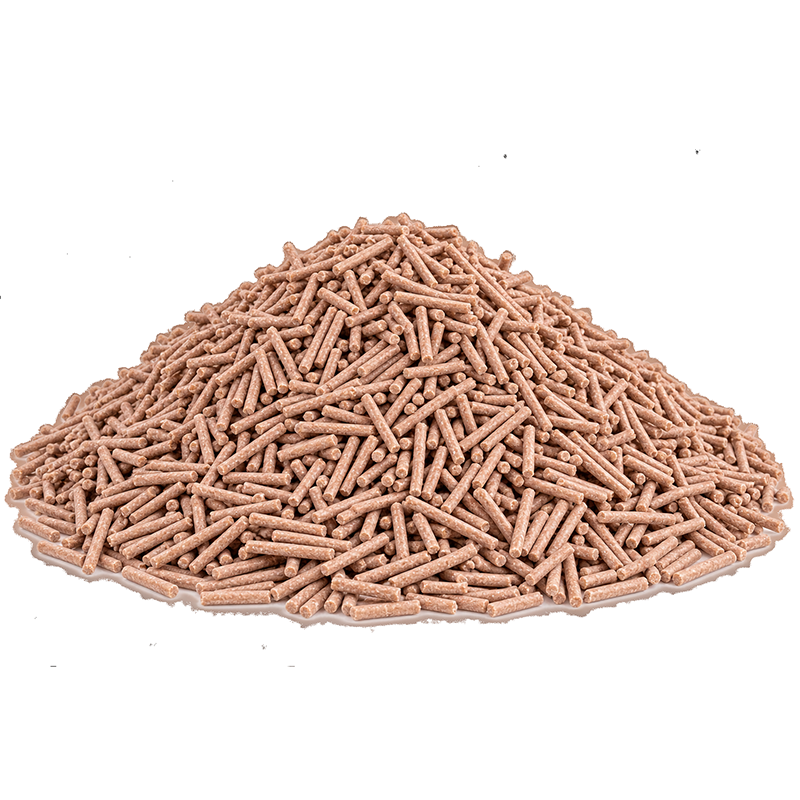
The composition of coffee-flavored tofu cat litter can vary between suppliers. Understanding the formulation helps buyers evaluate product performance, ingredient transparency, and suitability for different markets.
Tofu cat litter is commonly associated with soybean residue or other plant-derived materials used to form absorbent granules. The precise raw material and processing method depend on the manufacturer.
A suitable plant-based base should provide a balance of absorption, structural integrity, and clumping performance. Raw material consistency is important because variations in moisture content, particle size, and composition can affect the final product.
For B2B buyers, useful questions include:
What plant-derived materials are used in the litter?
Are the raw materials sourced consistently?
How is moisture content controlled during production?
What quality checks are performed on each batch?
Does the finished product meet the intended performance specifications?
A coffee-inspired product may use fragrance ingredients to create its characteristic aroma. Other formulations may use coffee-derived materials, but this should not be assumed without confirmation from the manufacturer.
These approaches are not interchangeable. A fragrance-based product does not necessarily contain coffee grounds, and a product containing coffee-derived material does not automatically have the same aroma or performance characteristics as one using a fragrance system.
If coffee-derived ingredients are present, buyers should request clear information about their identity, processing, concentration, and suitability for use in cat litter. They should also confirm that the material is not being used merely as an unverified substitute for a tested odor-control system.
Coffee grounds and other coffee residues can vary in composition and moisture content. They should not be assumed to improve absorbency, odor control, or clumping unless the finished formulation has been tested.
Fragrance intensity can influence whether a cat accepts a litter. Cats have a highly developed sense of smell, and a scent that seems pleasant to a person may be overwhelming or unfamiliar to an individual cat.
A suitable formulation should balance the intended aroma with the needs of the animal and the household. Strong fragrance is not necessarily a sign of better odor control.
When evaluating a scented product, buyers should consider:
Whether the fragrance is clearly identified in the product documentation.
Whether fragrance intensity remains reasonably consistent between batches.
Whether the aroma changes noticeably during storage.
Whether the formulation has appropriate safety documentation.
Whether cats show signs of avoiding the litter box after a product change.
A fragrance-free option may be preferable for cats or households that are sensitive to scented products.
Some tofu cat litter formulations use binders or processing aids to help maintain granule shape and clumping behavior. The type and amount used depend on the manufacturing process.
Ingredient information should distinguish the plant-based absorbent material from binders, fragrances, and any additional functional ingredients. Clear formulation documentation helps distributors compare products and supports more accurate product labeling.
Coffee-flavored tofu cat litter combines the general properties of a tofu-based litter with a coffee-inspired scent. The following features are potential product attributes rather than guaranteed characteristics of every formulation.
Tofu cat litter is often selected as an alternative to mineral-based products. Its plant-derived base may appeal to consumers who prefer litter made from renewable raw materials.
However, “plant-based” does not automatically mean fully biodegradable, compostable, or suitable for every disposal method. Those claims depend on the complete formulation, applicable testing, and local waste-management requirements.
The coffee scent differentiates this product from unscented tofu litter and other fragrance profiles. It may appeal to consumers who prefer a recognizable aroma in the litter area.
The actual scent experience depends on the fragrance system, its concentration, packaging, storage conditions, and the surrounding environment.
If the product is formulated as a clumping tofu litter, users can remove urine clumps and solid waste regularly. This may reduce the need for frequent full-box replacement compared with some non-clumping products.
The practical benefit depends on how well the clumps hold together and how much clean litter is lost during scooping.
Some tofu cat litter products are designed in lightweight granule or pellet formats. Compared with certain dense mineral litters, a particular tofu formulation may be easier to lift, pour, and transport.
The actual weight advantage depends on the material density, packaging size, and moisture content. Product weight should be verified using the supplier's specifications.
Coffee-flavored tofu cat litter can potentially be offered in different package sizes for household users, pet shops, online retailers, and bulk distributors.
Packaging may include resealable bags, standard retail pouches, or larger commercial formats. The appropriate option depends on storage requirements, shipping costs, shelf presentation, and the purchasing habits of the target market.
Some cat owners prefer a scented litter because they want a particular aroma in the room where the litter box is located. Coffee-flavored tofu cat litter offers an alternative to floral, citrus, or other conventional fragrance profiles.
However, the preference of the human user should not override the cat's comfort. If a cat avoids the litter box, scratches around the edges without entering, or begins eliminating elsewhere after a change, the fragrance may be one possible contributing factor.
For clumping formulations, regular removal of urine clumps and solid waste can make daily maintenance more straightforward. Users should scoop at an appropriate frequency and replace litter as needed according to product instructions and actual cleanliness.
A product that produces weak or crumbly clumps may require more effort, even if its aroma is appealing. Therefore, cleaning convenience should be evaluated through actual use rather than fragrance alone.
When clumps remain intact and the uncontaminated litter stays clean, users may be able to remove waste without discarding the entire contents of the box every day.
This does not eliminate the need for periodic litter replacement and box washing. The required schedule depends on the number of cats, litter-box size, product instructions, ventilation, and household hygiene practices.
Plant-based tofu litter provides another option for consumers who want to compare different litter materials. Some users may prefer its texture, weight, or handling characteristics.
Nevertheless, cats differ in their preferences. A gradual transition is generally more appropriate than assuming every cat will accept a new litter immediately.
For retailers and distributors, coffee-flavored tofu cat litter can provide a scent variation within a broader plant-based litter range. It may be positioned alongside unscented tofu litter, other scented varieties, and different granule sizes.
The success of a new scent variant depends on customer demand, formulation quality, pricing, packaging, and repeat-purchase behavior.
Product specifications are essential for comparing suppliers and establishing consistent purchasing standards. The table below is a procurement template, not a claim about the exact specifications of a particular product.
| Specification | What Buyers Should Check |
|---|---|
| Product type | Coffee-flavored tofu cat litter |
| Main absorbent material | Confirm the exact plant-derived ingredients |
| Coffee component | Identify whether it is fragrance, coffee-derived material, or another ingredient |
| Granule shape | Confirm pellet, cylindrical, irregular, or other format |
| Granule dimensions | Request the manufacturer's measured size range |
| Absorption performance | Request test results and the testing method |
| Clumping performance | Evaluate clump integrity and ease of scooping |
| Dust level | Request a defined test method and measured result |
| Fragrance intensity | Assess through a sample and agreed evaluation criteria |
| Moisture content | Request the actual specification and tolerance |
| Color | Confirm the standard product appearance |
| Net weight | Verify package weight and permitted tolerance |
| Packaging | Confirm bag material, closure, labeling, and carton configuration |
| Shelf life | Follow the manufacturer's validated storage and shelf-life guidance |
| Disposal guidance | Confirm permitted disposal methods and local restrictions |
| Quality documentation | Request relevant test reports and safety information |
A specification is useful only when the measurement method is clear. For example, absorption values can differ depending on the liquid used, sample preparation, contact time, drainage method, and calculation formula.
Similarly, dust claims may be based on different particle-size thresholds or test equipment. Two suppliers may report numbers that are not directly comparable if their methods differ.
For a reliable purchasing decision, request both the numerical result and the method used to obtain it. Establish acceptance criteria before approving bulk production.
Absorption is one of the most important properties of cat litter because it affects moisture management, clump formation, and litter-box cleanliness.
Absorption rate describes how quickly the litter takes up liquid under defined conditions. Rapid uptake may help reduce the amount of free liquid remaining on the surface, but speed alone does not determine overall performance.
A meaningful test should use a defined sample mass, liquid volume, temperature where relevant, and observation period. The test should also identify whether the measured value represents liquid retained or liquid initially absorbed.
Absorption capacity measures how much liquid a given quantity of litter can take up under specified conditions. The result may be expressed as a mass ratio, volume ratio, or percentage.
Because different testing methods produce different results, buyers should not compare isolated absorption figures without checking the test procedures.
For clumping products, absorption should be assessed together with the integrity of the resulting clump. A litter may absorb a substantial amount of liquid but still produce a weak clump that breaks apart during removal.
A practical test can evaluate clump formation at several intervals, followed by a standardized lifting or handling procedure. The evaluation should record residue, breakage, and the amount of clean litter removed along with the clump.
The first few uses may not reveal how a litter behaves after repeated urination and scooping. Testing should consider whether the remaining material becomes excessively damp, produces persistent residue, or develops unpleasant odors under normal cleaning conditions.
For commercial quality control, repeated-use observations can complement laboratory absorption measurements.
Odor control is frequently a major reason consumers consider scented cat litter. However, the relationship between fragrance and odor management needs to be understood correctly.
A coffee-inspired fragrance changes the smell perceived by the user. It may mask some unpleasant odors, but it does not necessarily remove the compounds responsible for them.
Odor control may also depend on the litter's moisture absorption, clumping performance, and any specifically tested odor-control ingredients.
Product descriptions should distinguish between a coffee scent, odor masking, and demonstrated odor reduction. These terms describe different functions and should not be used interchangeably.
Even a well-formulated litter cannot compensate for inadequate cleaning. Urine clumps and solid waste should be removed regularly, and the litter box should be washed and replenished according to the product instructions.
A covered box may retain odors, while an uncovered box may provide better ventilation but allow more litter to scatter. The appropriate arrangement depends on the cat's behavior, household layout, and cleaning routine.
A strong scent may be attractive to some human consumers but uncomfortable for some cats. Cats may respond differently to the same formulation, so there is no universal fragrance intensity that suits every animal.
When introducing coffee-flavored tofu cat litter, observe the cat's behavior. A gradual transition can help identify acceptance problems before the new product fully replaces the existing litter.
For B2B buyers, odor-control claims should be supported by a defined evaluation method. Useful information includes the test conditions, sample size, duration, comparison product, and criteria used to evaluate odor.
If a supplier claims that a product provides extended odor control, ask how that duration was established and under what conditions it applies. Avoid translating laboratory results into universal household guarantees.
Dust and tracking affect cleanliness, comfort, and user satisfaction. They should be assessed independently because a product may perform well in one area but less effectively in the other.
Dust may originate from fine particles created during raw material processing, granule formation, drying, screening, packaging, or transport. Granules can also break down during use.
Manufacturers can manage dust through suitable raw material preparation, particle screening, granule-strength control, and finished-product inspection. The effectiveness of these measures should be confirmed through testing.
Terms such as “low dust” or “dust reduced” should be supported by a clear test method. Buyers should ask which particles are counted, how the sample is handled, and whether the result represents the finished packaged product.
Visual inspection alone may not detect all fine particles. Where dust performance is important, use documented measurements and a consistent acceptance standard.
Tracking occurs when litter granules or fragments cling to paws and fur. It can be affected by granule size, shape, surface texture, and the cat's movement after leaving the box.
A litter mat may reduce the amount of material spread around the room, but it cannot eliminate tracking entirely. The choice of mat should also avoid creating an uncomfortable surface that discourages the cat from using the box.
Smaller granules may feel more similar to sand for some cats, while larger pellets may reduce certain types of scattering. However, neither size is universally better.
Granule dimensions should be evaluated alongside absorption, clumping, tracking, and cat acceptance. Buyers should test the finished product instead of selecting a size based on a single performance claim.
Because cats spend time close to their litter and may lick their paws during grooming, formulation transparency is important.
A coffee-inspired scent does not necessarily mean the product contains coffee or caffeine. Buyers should confirm the exact ingredient system rather than assuming the product is made from coffee grounds.
If coffee-derived materials are used, the manufacturer should provide details about their identity, processing, and intended use. Caffeine-containing residues should not be presumed safe simply because they are incorporated into a litter product.
Coffee and caffeine can be harmful to cats when ingested in sufficient quantities. Therefore, products containing coffee-derived ingredients require careful formulation review and appropriate safety assessment. Do not allow cats to eat the litter, and contact a veterinarian promptly if a cat ingests a potentially harmful ingredient or develops concerning symptoms.
Cats may be sensitive to strong or unfamiliar smells. A product should not rely on intense fragrance as a substitute for effective moisture management and routine cleaning.
If a cat shows repeated sneezing, irritation, avoidance of the box, or other concerning changes after a litter switch, stop using the new product and seek veterinary advice when appropriate. These signs can have multiple causes, so they should not automatically be attributed to fragrance alone.
Cat litter is intended for use in the litter box, not as food. Keep bags and loose litter away from pets that chew non-food materials, and follow the manufacturer's guidance regarding accidental ingestion.
Do not describe a litter as edible or harmless to ingest unless that claim is supported by appropriate evidence and is consistent with its intended use.
Retailers and distributors should request relevant safety documentation, ingredient disclosures, and any applicable test reports. The exact documents required depend on the product formulation and the laws of the destination market.
Claims such as “non-toxic,” “chemical-free,” or “completely safe” should not be used without adequate substantiation. Clear, limited, evidence-based language is more reliable than absolute safety guarantees.
Tofu cat litter is often marketed as a plant-based alternative, but biodegradability depends on the complete product rather than its main ingredient alone.
The plant-derived base may be biodegradable under suitable conditions. However, fragrances, binders, processing aids, coatings, and other additives may affect how the finished product behaves during disposal.
Biodegradability and compostability are related but different concepts. A biodegradable material may break down under particular environmental conditions, while compostability generally involves additional criteria and a defined process.
Consumers should not assume that coffee-flavored tofu cat litter can be placed in a home compost system. Cat waste may contain pathogens, and composting requirements differ depending on the intended use of the compost and local regulations.
Some tofu cat litter products are marketed as flushable, but flushability should never be inferred from a plant-based composition alone.
Plumbing systems, septic systems, wastewater infrastructure, and local regulations vary. Even material that breaks apart in water may cause problems when used in unsuitable pipes or systems.
Users should follow the exact product instructions and local wastewater guidance. When the instructions are unclear, disposal through an approved solid-waste route is the more cautious choice.
Manufacturers and sellers should distinguish among plant-derived content, biodegradability, compostability, and flushability. Each claim needs appropriate support.
For example, “made with plant-derived materials” describes a material source, while “certified compostable” implies a specific standard or certification. These claims should not be treated as equivalent.
Correct use helps maintain cleanliness and makes it easier to assess whether the product suits the cat.
Wash and dry the litter box before introducing a new product. Avoid leaving strong cleaning-product residues that may interfere with the cat's willingness to use the box.
Select a box with enough space for the cat to enter, turn around, dig, and cover waste comfortably.
Follow the manufacturer's instructions for litter depth. If no clear depth is provided, ask the supplier for guidance based on the product's granule size and clumping behavior.
Too little litter may allow urine to reach the bottom of the box, while excessive depth may increase scattering and unnecessary product use.
Cats may be sensitive to changes in texture and scent. When transitioning from another litter, gradually mix the new product with the existing litter if the cat tolerates mixed materials.
Increase the proportion of the new litter over time while monitoring the cat's behavior. Some cats may need a longer adjustment period, and some may not accept a scented formula.
Scoop solid waste and urine clumps as frequently as needed to keep the box clean. For clumping products, allow sufficient time for clumps to form before scooping, based on the manufacturer's guidance.
Remove broken clumps and contaminated material rather than leaving residue in the box.
Add fresh litter when needed to maintain the recommended depth. Replace the litter and clean the box at suitable intervals according to the product instructions and actual conditions.
Do not use fragrance strength as the sole indicator of cleanliness. A litter that still smells like coffee may nevertheless require cleaning or replacement.
Observe whether the cat enters the box comfortably, digs normally, and continues its usual elimination habits.
Avoid forcing a cat to use a product that it consistently rejects. If litter-box avoidance persists or is accompanied by signs of discomfort, consult a veterinarian to rule out medical causes.
Different litter materials have different performance characteristics. The following table provides a general comparison; actual performance depends on the formulation and testing.
| Litter Type | Typical Material | Common Characteristics | Main Considerations |
|---|---|---|---|
| Coffee-flavored tofu cat litter | Plant-derived tofu litter base with a coffee-inspired scent or specified coffee-related ingredient | Plant-based format; fragrance variation; may be clumping | Confirm fragrance ingredients, clumping strength, and cat acceptance |
| Unscented tofu cat litter | Plant-derived tofu litter base | Similar material category without added scent | May suit households that prefer to avoid fragrance |
| bentonite cat litter | Clay-based mineral material | Often available in clumping formulations | Weight, dust, tracking, and disposal vary by product |
| Silica gel cat litter | Porous silica-based granules | Moisture absorption; some products are non-clumping | Texture acceptance, disposal, and product-specific instructions |
| Pine cat litter | Processed wood-based material | Available in pellet and other formats | Absorption, breakdown behavior, and odor profile vary |
| Paper cat litter | Recycled or processed paper fibers | Often available in non-clumping forms | Bulk, moisture handling, and cleaning frequency depend on formulation |
| Cassava cat litter | Cassava-derived plant material | Plant-based alternative; some products are clumping | Ingredient composition, performance, and price vary |
| Corn-based cat litter | Corn-derived plant material | May offer clumping and plant-based characteristics | Ingredient transparency, storage, and moisture control matter |
The primary distinction is the scent profile or additional ingredient system, not necessarily the absorbent base.
If both products use comparable tofu-based formulations, their absorption and clumping performance may be similar. However, added fragrance or other ingredients can affect the overall product, so equivalence should be confirmed rather than assumed.
Unscented litter may be a better choice for cats that dislike fragrances or for households seeking to minimize added scent. Coffee-flavored litter may appeal to buyers who specifically prefer a scented option and whose cats tolerate it.
Bentonite litter is a mineral-based category commonly associated with clumping products. Tofu litter uses plant-derived materials and may offer different handling and disposal characteristics.
Neither category is universally superior. A fair comparison should consider absorption, clump strength, dust, tracking, package weight, cost per use, and the cat's preferences.
Pine litter generally uses wood-derived materials, while tofu litter is commonly based on soybean residue or other plant-derived ingredients.
Their textures, scents, and breakdown behavior may differ considerably. Consumers should compare actual samples and verify disposal instructions for each finished product.
Paper litter is often made from processed paper fibers and may be available in non-clumping formats. Tofu litter is frequently marketed in clumping formats, although product designs vary.
The more suitable option depends on the cat's preferences, cleaning routine, moisture-management needs, and product-specific performance.
Packaging protects the litter from moisture, contamination, and physical damage during storage and distribution.
Plant-based litter can be affected by environmental moisture. Excessive moisture may change granule texture, contribute to clumping inside the bag, or reduce storage stability.
Packaging should provide an appropriate moisture barrier for the product and its distribution conditions. The required level depends on the formulation, storage climate, and expected shelf life.
Retail packs should communicate the product type, net weight, ingredients or material information as required, directions for use, storage guidance, and disposal instructions.
For scented litter, the coffee-inspired aroma should be described accurately. Packaging should not imply that the product contains edible coffee ingredients unless that is true and properly disclosed.
Commercial buyers may require larger bags, master cartons, or palletized shipments. The best format depends on warehouse capacity, handling equipment, transportation costs, and the target sales channel.
Before confirming a bulk order, review package dimensions, net and gross weights, carton quantity, pallet configuration, and shipping requirements.
Store the product in a dry, clean environment and protect it from direct moisture exposure. Keep packages sealed when possible and follow the manufacturer's recommended temperature and storage conditions.
Retailers should use a stock-rotation system and check packaging condition before dispatch. Damaged or moisture-compromised bags should be assessed before sale.
For importers, distributors, pet retailers, and private-label brands, selecting a coffee-flavored tofu cat litter supplier requires more than comparing unit prices.
Request a clear description of the absorbent base, fragrance system, and any coffee-derived ingredients. A product name alone does not establish its composition.
If the product is being marketed as coffee-flavored, clarify whether the description refers to fragrance, ingredient content, or both. This distinction is important for accurate labeling and customer communication.
Samples allow buyers to evaluate aroma, granule size, pouring behavior, dust, clumping, and package presentation.
Testing should be performed under consistent conditions. If multiple suppliers are being considered, use the same test procedures and record the results.
A purchase agreement should define relevant quality parameters, test methods, permitted tolerances, packaging standards, and procedures for handling nonconforming batches.
Useful quality indicators may include moisture content, granule dimensions, absorption performance, clump integrity, dust level, and fragrance consistency. Select parameters that are meaningful for the specific product rather than requiring unsupported universal thresholds.
A sample may perform well while later production batches differ. Buyers should ask how the manufacturer controls raw material variation, processing conditions, fragrance dosage, and finished-product inspection.
Where appropriate, agree on reference samples and documented acceptance criteria before mass production.
Destination-market requirements can differ. Buyers should confirm the labeling, ingredient disclosures, safety documentation, packaging rules, and import requirements applicable to their market.
Do not assume that documentation accepted in one country automatically satisfies requirements elsewhere. Product claims should be reviewed for accuracy and local compliance.
The lowest unit price may not produce the lowest overall cost. Consider shipping weight, packaging volume, damage rates, storage requirements, product performance, customer complaints, and repeat-purchase potential.
A consistent product that meets customer expectations may offer better long-term value than a cheaper product with variable quality.
Private-label projects may require custom branding, packaging artwork, package sizes, barcode placement, language adaptation, and carton markings.
Before production, confirm artwork approval procedures, minimum order quantities, lead times, production capacity, and quality-control responsibilities. These terms should be agreed with the supplier rather than assumed.
A structured evaluation helps consumers and business buyers compare products more objectively.
Prioritize the following:
Cat acceptance: The cat should be willing to enter and use the litter box normally.
Ingredient transparency: Confirm the material base and the nature of the coffee-inspired scent.
Absorption: The litter should manage moisture effectively under normal use.
Clumping: If clumping is important, check whether clumps remain intact during scooping.
Dust and tracking: Evaluate the amount of dust and granules spread around the box.
Fragrance strength: Choose a scent level that does not appear to disturb the cat.
Cleaning requirements: Follow the product instructions and assess how easy the box is to maintain.
Disposal: Use only methods permitted by the product guidance and local rules.
Focus on:
Consistent formulation and ingredient disclosure.
Documented absorption and clumping performance.
Clearly defined dust and moisture specifications.
Stable fragrance characteristics between batches.
Suitable packaging for retail and transport.
Reliable supply and quality-control procedures.
Accurate labeling and substantiated marketing claims.
Competitive total landed cost.
Customer feedback and repeat-purchase potential.
Private-label buyers should also evaluate brand positioning. Coffee-flavored tofu litter may fit a product range that includes other scented and unscented plant-based options.
However, the product should be differentiated through verifiable attributes such as material transparency, package convenience, granule design, or demonstrated performance—not through unsupported claims about safety, environmental impact, or superior odor elimination.
A pleasant smell does not prove that a litter absorbs well or forms strong clumps. Evaluate the product's functional performance separately from its scent.
The word “coffee-flavored” does not establish that coffee grounds or coffee-derived materials are present. Request the ingredient information.
Plant-derived composition does not guarantee that a product is suitable for toilets, septic systems, or every drainage network. Follow the product's instructions and local requirements.
A litter that appeals to a person may not suit a particular cat. Monitor behavior during the transition and consider an unscented alternative if the cat avoids the box.
Absorption and dust figures are difficult to compare when suppliers use different test methods. Request the testing details before drawing conclusions.
Moisture exposure and damaged packaging can affect product quality. Storage and transport conditions should be included in purchasing and warehouse procedures.
Terms such as “100% safe,” “chemical-free,” “zero dust,” and “completely biodegradable” require careful substantiation. Use specific, evidence-based product descriptions instead.
It is generally a tofu-based plant litter with a coffee-inspired aroma. The exact formulation may use a fragrance, coffee-derived material, or another ingredient system. Buyers should review the manufacturer's ingredient information to confirm the actual composition.
Not necessarily. “Coffee-flavored” may describe the aroma rather than the presence of coffee beans or grounds. Check the ingredient list and product documentation before making assumptions about its contents.
It may help manage the litter-box environment through its absorbent base and any tested odor-control ingredients. The coffee aroma itself may mask some odors, but fragrance does not automatically mean that odor-causing compounds have been removed.
Many tofu cat litter products are designed to clump, but not every formulation behaves the same way. Confirm the product description and test clump integrity under realistic conditions.
Safety depends on the complete formulation, ingredient quality, and intended use. Buyers should confirm the ingredient information and relevant safety documentation. If coffee-derived materials are used, their suitability and caffeine-related risks should be specifically assessed. Cats should not be allowed to eat the litter.
Acceptance varies between individual cats. Some may tolerate a scented litter, while others may prefer an unscented product. Introduce a new litter gradually and monitor litter-box behavior.
Dust levels depend on raw materials, granule durability, screening, processing, and packaging. A low-dust claim should be supported by a defined test method and measured result.
Do not assume it is flushable simply because it is plant-based. Follow the manufacturer's explicit instructions and local plumbing or wastewater guidance. When flushability is not clearly established, use an approved solid-waste disposal method.
The plant-derived base may be biodegradable under suitable conditions, but the complete formulation determines the behavior of the finished product. Confirm any biodegradability or compostability claim through appropriate documentation.
Scoop solid waste and urine clumps regularly. Add fresh litter as needed and replace the contents and clean the box according to the manufacturer's instructions, the number of cats using the box, and actual hygiene conditions.
Keep it in a dry, clean environment and protect it from moisture. Reseal opened packaging where possible and follow the supplier's storage guidance.
Wholesale buyers should ask about the exact ingredients, fragrance system, absorption and clumping test methods, dust specifications, moisture limits, packaging options, quality-control procedures, documentation, minimum order quantity, lead time, and batch consistency.
Customization may be available depending on the supplier. Potential options include branding, packaging design, package weight, granule format, and fragrance profile. Buyers should confirm the available options, minimum order requirements, production lead time, and documentation before committing to an order.
Neither is universally better. The scented version offers a different aroma profile, while unscented litter avoids added fragrance. Absorption, clumping, dust, ingredient transparency, and cat acceptance should guide the decision.
There is no single specification that determines overall quality. For most buyers, the key areas are ingredient transparency, absorption, clumping performance where applicable, dust control, fragrance consistency, and documented safety information.
Coffee-flavored tofu cat litter is a specialized option within the broader plant-based cat litter category. It combines a tofu-based litter format with a coffee-inspired aroma, offering a distinctive alternative to unscented tofu litter and other fragrance varieties.
Its practical value depends on more than scent. Absorption, clumping behavior, dust generation, tracking, ingredient transparency, storage stability, and cat acceptance all contribute to the user experience. The phrase “coffee-flavored” should also be interpreted carefully because it does not necessarily indicate that the product contains coffee grounds or other coffee-derived materials.
For consumers, the most reliable approach is to evaluate the complete formulation, introduce the litter gradually, maintain the litter box consistently, and observe the cat's response. For wholesalers and private-label buyers, supplier verification, standardized testing, batch consistency, appropriate documentation, and accurate labeling are essential.
A well-evaluated coffee-flavored tofu cat litter product should offer clearly described characteristics supported by relevant product information. By focusing on measurable performance and transparent ingredients rather than aroma alone, buyers can make more informed decisions for household use and commercial purchasing.
 RELATED
 RELATED
 RELATED
 RELATED
واتس اب
صندوق البريد

يستخدم هذا الموقع ملفات تعريف الارتباط لضمان حصولك على أفضل تجربة على موقعنا.

 English
 Pусский
 Deutsch
 中文

 واتس اب
 هاتف
 صندوق البريد
 رسالة